Showing posts with label boxers. Show all posts

Sunday, September 8, 2013

Sunday Series: The Elephant Village of Ayutthaya

All the world was quiet on the drive to Ayutthaya.

Green fields spanned miles in each direction.  The highway reached endlessly forward, persisting beyond the horizon with the vigilance and certainty of ever forward-marching time.  Every few miles, a lonely, dilapidated stall on the side of the highway selling food or hats.  Signs hanging down with their worn faces frowning at the world, paint peeling and fabric torn, a small wrinkled woman selling those hats and looking somewhere in the distance through tired eyes from a plastic seat.  Rolling on, life hurled down the road, on motorcycles, in cars, in buses, in taxis, on two feet.

As we reached our destination after an hour long drive through the countryside of Thailand, I stopped and gazed in wonder, I stopped -


There were no words as I saw the elephants begin to saunter slowly by our taxi.  Amid the crumbling ruins of what used to be the Kingdom of Siam's capital in 1350, gentle giants wander the streets as fellow citizens and residents.  For 500 baht (about $15 USD) you can ride the elephants through the ruins of the city.  You can watch as the trainers work with the elephants to dance and put on a show.  In fact, you can sit next to a baby elephant and have lunch with him as he tries to steal your poached quail eggs.

Instead of words to express this kind of joy, I offer this photograph, which captured the moment perfectly:


So began my adventures in Ayutthaya, where I spent the day riding elephants and roaming the ruins.

The Ruins of Ayutthaya

Around 1600 B.C., the city of Phra Nakhon Si Ayutthaya was one of the most populated cities in the world with about 300,000 residents.  In 1350, the city swelled to over one million and became the capital of the Kingdom of Siam.  For hundreds of years, the city dominated Asian trade wind commerce.  Of the city, Asian myth and folklore was borne; the city offered merchants astounding views of 400 glittering temples jutting out from the green of the jungle, art, gold, and treasures beyond wildest dreams.  During its 417-year life, 33 kings ruled Ayutthaya and brought 70 wars to the kingdom.  Alas, like Rome, all cities eventually fall.  In 1767, the city was destroyed by the Burmese army.  The temples were sacked and the goods stolen.  However, due to a resurgent interest in the temples in the sixties, the site has undergone massive restoration in the past several decades.  In the seventies, officials renovated the city and it became a UNESCO world heritage site.  Today, the Ayutthaya Historical Park attracts thousands of visitors every year to see the mythic ruins of a once-ruling empire.
"Prang" or reliquary towers of the central renovated structure.

Located about one hour north of Bangkok, Ayutthaya sits comfortably away from the noise of the city and is another hour away from a few other must-see destinations, such as Lopburi to the north (monkeys!) and Kanchanaburi to the west (tigers! jungles!).  The city itself sits on an island at the head of the Gulf of Siam, surrounded by three rivers that connect to the ocean.  To ancient kings, the location made sense - it was relatively safe from floods, invited a booming merchant trading system due to its canals and waterways, and offered safety from passing warships of rival nations.  The

Ayutthaya is known as the "Venice of the East" and for good reason.  In striking similarity to the Renaissance-minded city planning of Leonardo da Vinci or the great Aztec metropolis, ancient architects laid out the city according to a systematic grid.  The citizens of Ayutthaya were innovators; they planned and built hydraulic waterways, a technical marvel unique to all the world at the time it existed.  The intricate structural outline of the city still exists today and makes for some of the most amazing photography to come out of Thailand's architecture.

The entrance fee is 50 baht (about $1.50 USD) and is open from 8am to 4pm.  Bring walking shoes, a good camera, and a guidebook to read about the temples and ruins in between enjoying the local food from street stalls and shopping in the endless, crowded fair set up just outside the ruins.
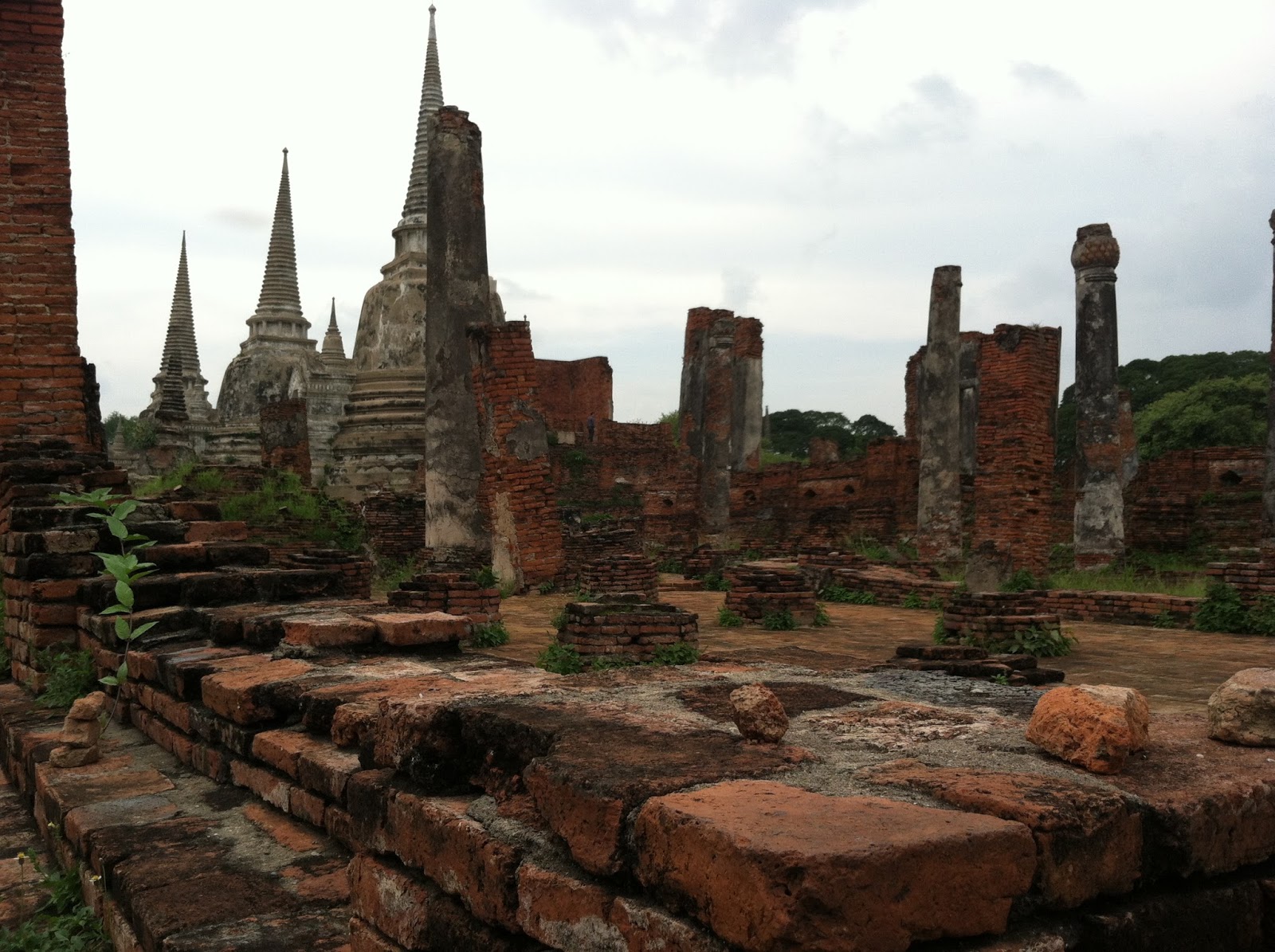
Though in ruin, the inherent geometric beauty of the city layout remains.

The Ayutthaya Elephant Village

For most people, riding elephants ranks high on the bucket list.  For a mere $15 USD (500 baht), you can scratch this one off the list.  One of the elephant trainers will seat you atop your very own elephant and walk you around the ruins.


After the ride is over, there is a souvenir shop where proceeds go directly to helping the elephants.  Walk around the village and get lost in the endless market full of every kind of food imaginable.


Wednesday, September 4, 2013

สำหรับประสบการณ์ที่ "For the Experience"

After seven long hours of training, I was ready for my first Saturday in Thailand to come to an end.  I was in a state of blissful exhaustion; one of those moods where all you want to do is absorb the environment around you rather than participate in it.

The Thai evening began its warm embrace of darkness and jungle sweat - from waxy green leaves rose a mysterious and enduring symphony of endless insects, vendors ran out of coconuts, and nocturnal millipedes glided gracefully across the black asphalt like shadows.  Street dogs lay on the side of the road in a coma-like sleep.  Food stalls were draped off with tarps and the lonely flourescent light of the 7-11 burned on into the coming night.

Yet on this night, the camp was far from asleep; the cars and vans of the gym owners sat waiting, loaded with Thai fighters and farang (foreigners), ready to make a two-hour trek to the rural wilds of Bangkok, Amphawa Samutsongkram.  There was not enough room for everyone to go; the owners shuffled us around, talking to each other frantically in Thai.  I lucked out; the manager offered me a seat in the car with one of the trainers and two of the fighters who would be competing that night.

I rode with two fighters, both from vastly different worlds.  One was an Italian who had been fighting in Bangkok intermittently for the past several years.  The first time I met him was on one of the morning 10k runs; he was running through the wet heat of Bangkok...in a sweat suit.  Running through the most intense heat and humidity I had ever experienced...practically wrapped in a body bag, a thick black plastic suit for weight cutting.  He smiled as he recognized me from the gym, jogging by with a cordial Hello.  I was humbled immediately; not only did fighters run in this heat, they ran in this heat in sweat suits, and did it with a smile.

The second fighter was a thirteen-year-old Idaho boy with a lisp named Hunter.  You would never suspect by looking at him that he had over forty professional Muay Thai fights under his belt, or that he had lived in Japan and in fact spoke Japanese, or that he was living in Bangkok alone.  I no doubt believed him when he stated, authoritatively and without the slightest hesitation, "I will fight in the UFC when I grow up."  This thirteen-year-old was far more fearless and wise than many adults I knew.

"I hate it when other kids think I'm just some sort of nerd, or that I can't fight." He laughed with a kind of self-assurance most men couldn't muster, musing that "I can always kick their ass, though!"

I wondered in awe at how someone could be so young and already have lived so fiercely, so fully, so fantastically.  I wondered in awe at how I could be so privileged as to meet such amazing and inspiring people.

In the midst of this reverie, we made a 7-11 stop so that the Italian could refuel.  Come to find out that not only had he been cutting weight, but that his weigh-in was only an hour --- one hour --- before his fight.  He sat in the backseat sucking down a coconut before passing out for the rest of the ride, trying to get back some iota of the energy drained away running through Bangkok in a sweat suit.
Amphawa Floating Market, Thailand

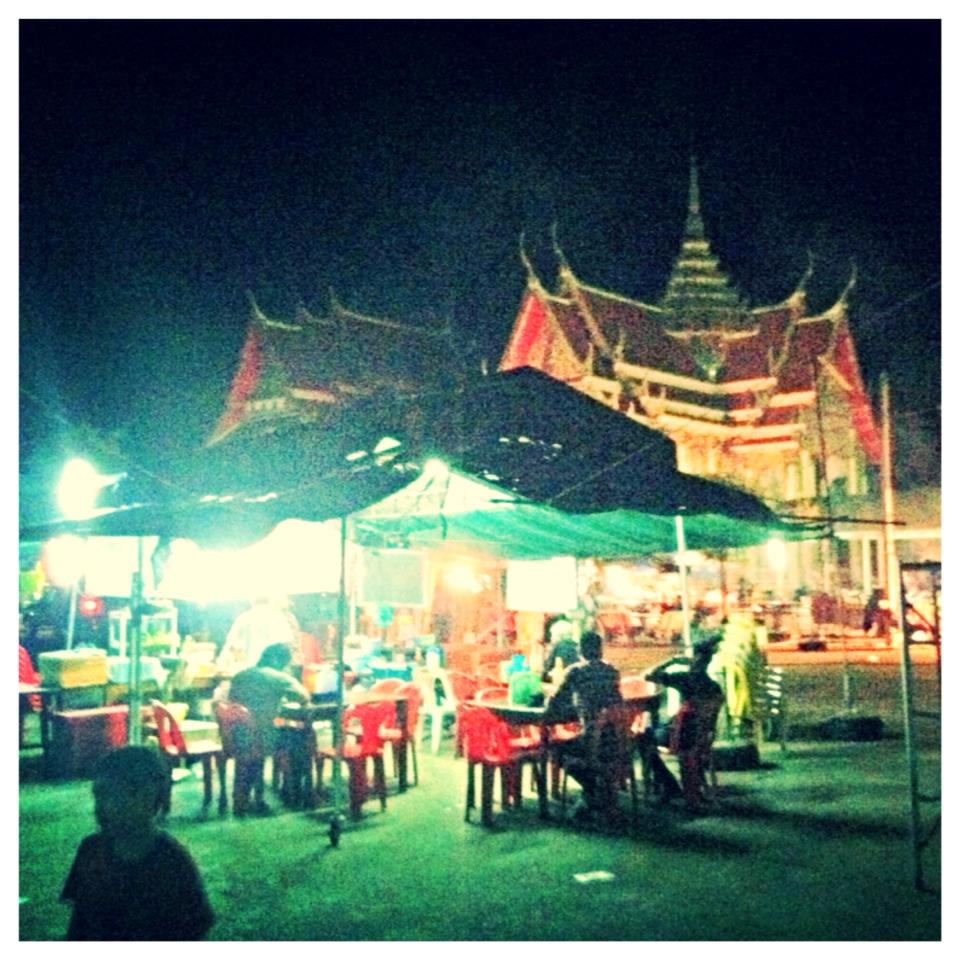
We arrived in Amphawa at almost ten at night.  The stadium was an open-air festival, a stage set up on wild grass and between decaying, ancient Thai buildings.  Amphawa is a sleepy river town known mostly for its floating market, but when the boats are docked and Saturday night sets in, the town comes alive for Muay Thai.  Hundreds of spectators stand or sit in folding chairs, sandwiched between ice cream vendors and the giant dancing stage pulsating with live music and gyrating half-naked Thai women.  Outside the archways and beyond the grass, street food vendors fill the paved parking lot, filling the air with the scent of fried meats and the sugary-sweet of Cokes from glass bottles.
Food Vendor outside the stadium fights of Amphawa

Full rules Muay Thai was already underway as we crowded backstage to prepare the fighters.  They were rubbed down head to toe in Thai oil and greased for the purpose of making it harder to land a deadly blow.  They lay on the pavement on worn grass mats, closing their eyes in focus, blocking out the world and its gyrating Thai women and screaming crowds.

We settled in to watch the fights before our Kaewsamrit fighters came on.  Hunter won his fight; the Italian lost.

As we drove home that night, the Thai coach told the Italian in broken English, "next time, you
Street food outside of the Amphawa fight arena

Entrance to Amphawa fight arena
fight for de experien."  The Italian paused for a moment, puzzled.  "If not for the experience, what then?"  The coach's English didn't stretch that far; the nuance of the abstraction was lost in translation.  Isn't all fighting for the experience, the experience of at least something, be it winning, money, or glory?  How does one fight for non-experience, other than to experience non-existence?  I thought of a quote I had just read from Siddhartha, about the way we experience life generally:

"When someone is seeking," said Siddartha, "It happens quite easily that he only sees the thing that he is seeking; that he is unable to find anything, unable to absorb anything, because he is only thinking of the thing he is seeking, because he has a goal, because he is obsessed with his goal.  Seeking means: to have a goal; but finding means: to be free, to be receptive, to have no goal.  You, O worthy one, are perhaps indeed a seeker, for in striving towards your goal, you do not see many things that are under your nose."  -Herman Hesse, Siddartha

What I took the coach to mean was this: if you focus only on winning or any other singular goal, you overwhelm yourself with tension and become blind to your opponent's maneuvers against you.  You lose the ability to "think like a fighter" and react to the situation you find yourself currently in, be it a clinch or a southpaw or a strange new style.  Many a fighting coach chants the familiar words to fighters, "relax, relax, relax."  What this means is to clear your mind of any goal, to focus only on absorbing the visceral reality of the situation, to trust utterly the instincts you have trained by merely following a flow of action and reaction based on the simple reality of what your senses perceive.  You see the punch, you block it.  You see the opening, you take it.  Bruce Lee explained it this way in his essay on gung fu:

"[the principle of gung fu] has to grow spontaneously, like a flower, in a mind free from emotions and desires.  The core principle of [this] is Tao - the spontaneity of the universe."

After explaining his initial frustrations with learning the "art of detachment" inherent in fighting, Lee explains his revelation further in his famous water analogy:

"On the sea I thought of all my past training and got mad at myself and punched the water!  Right then - at that moment - a thought suddenly struck me; was not this water the very essence of gung fu?  Hadn't this water just now illustrated to me the principle of gung fu?  I struck it but it did not suffer hurt.  Again I struck it with all of my might - yet it was not wounded!  I then tried to grasp a handful of it but this proved impossible.  This water, the softest substance in the world, which could be contained in the smallest jar, only seemed weak.  In reality, it could penetrate the hardest substance in the world.  That was it!  I wanted to be like the nature of water.
Lee continues, "Suddenly a bird flew by and cast its reflection on the water.  Right then as I was absorbing myself with the lesson of the water, another mystic sense of hidden meaning revealed itself to me; should not the thoughts and emotions I had when in front of an opponent pass like the reflection of the bird flying over the water?"

This was one possible interpretation of "for the experience."  As I contemplated what the coach's thoughts were, Hunter worked to help translate.  The coach spoke Thai and Japanese; Hunter spoke Japanese and English.  In a game of international telephone, Hunter asked the coach in Japanese what he had meant, then translating to English for the Italian.

"He means fight for the experience, as in don't focus just on winning or just on one thing.  Just relax, have fun, go with it, enjoy yourself," Hunter said.  Huh, I thought.  Not too far off the mark from what I was thinking of.

"Oh, okay, okay, I see what you mean," the Italian said.

As we drove home to the gym, mostly in silence, thunder and lightening lit up the entire skyline.  Rain loomed ahead of us, but the storm passed around us.  We drove on.  As the dark night flashed alive, I listened to the conversations in Thai and Japanese, devoid of meaning to me.  I sat empty, letting the world flow by and flow through me, absorbing as much of it as I could.

I closed my eyes and listened.  I thought of how unpredictable and at times extreme life in Bangkok could be, how wild and wonderful life in a Muay Thai camp was.  I savored it in its entirety, thinking of all the amazing things I had already done.

All amazing, if only I kept letting it be.  Fun, if only I kept letting go of fear.  An opportunity to truly grow and change, if only I kept relaxing.  All "for the experience."

Monday, August 19, 2013

Physics, Punches, and Gender Expectations: The Lucia Rijker Documentary

"So I punch like a girl...but maybe I could kick your ass."  -Lucia Rijker


"OMG, I am SOOOO into reading about love horoscopes.  It's like, totally something I follow about celebrities.  It's SOOOO interesting!" I heard this little gem from one of the girls sitting next to me on the plane to Honolulu.  No, not girls - these two next to me were girls in women's bodies.  They were mid-twenty somethings in terms of physical age, but mental middle-schoolers.  What a shame, I thought.  Six hours removed from media and internet; you could fill each of those hours with literary mental giants the likes of Whitman, Faulkner, Kerouac, Palahniuk.  Engage in the lost art of...thinking...real, introspective, substantive reflection and reading...sans computers.  But, no.  For six hours I watched them flip their hair, take plane selfies, and read magazines plastered with half-starved, photoshopped reality stars, idolizing them for...what, exactly?  For being followed by cameras?  For looking good?  For being shameless about a need for attention?  For having sex on camera?  For...an example?  An example of what?

Who else can girls really look up to these days?  And as an example of what?

For me, Lucia Rijker has always been a woman I look up to.  Not only as a fighter, but as an example of how a woman should be.  Strong and peaceful.  Powerful and classy.  Disciplined and determined.  Confident and kind.

Lucia Rijker
I've always loved the Lucia Rijker documentary Shadowboxers (see video above for YouTube link to documentary).  It highlights women's boxing in 1999, a primordial time in female combative sports in comparison to the modern-day Rousey era.  Moreover, it's a great look at Lucia Rijker "The Dutch Destroyer."  Dubbed "the most dangerous woman in the world," Rijker has a professional boxing record of 17-0, fourteen of which were by knockout.  Most of you might recognize her as "Billy the Blue Bear" from Million Dollar Baby.

More than a fighter, Rijker is a devoted professional martial artist in mind, body, and soul.  She is a Buddhist who speaks four languages, devoting daily energy to meditation and chanting.  She is the kind of woman you want to listen to whenever she speaks because you know there will be some deep-reaching wisdom to be found in her words about fighting, training, about life.  About more than horoscopes or celebrities or who's fucking who.

In this ten-minute clip from the show "Sports Science," Lucia breaks through expectations and proves that some women can in fact punch just as hard (if not harder) than men.  Her punches answer the doofy question in the beginning, "can a GIRL possibly hit as hard as a GUY?!?" with a solid, "of course, and as a measurable fact, I punch harder than a lot of guys."