Sunday, September 8, 2013

Sunday Series: The Elephant Village of Ayutthaya

All the world was quiet on the drive to Ayutthaya.

Green fields spanned miles in each direction.  The highway reached endlessly forward, persisting beyond the horizon with the vigilance and certainty of ever forward-marching time.  Every few miles, a lonely, dilapidated stall on the side of the highway selling food or hats.  Signs hanging down with their worn faces frowning at the world, paint peeling and fabric torn, a small wrinkled woman selling those hats and looking somewhere in the distance through tired eyes from a plastic seat.  Rolling on, life hurled down the road, on motorcycles, in cars, in buses, in taxis, on two feet.

As we reached our destination after an hour long drive through the countryside of Thailand, I stopped and gazed in wonder, I stopped -


There were no words as I saw the elephants begin to saunter slowly by our taxi.  Amid the crumbling ruins of what used to be the Kingdom of Siam's capital in 1350, gentle giants wander the streets as fellow citizens and residents.  For 500 baht (about $15 USD) you can ride the elephants through the ruins of the city.  You can watch as the trainers work with the elephants to dance and put on a show.  In fact, you can sit next to a baby elephant and have lunch with him as he tries to steal your poached quail eggs.

Instead of words to express this kind of joy, I offer this photograph, which captured the moment perfectly:


So began my adventures in Ayutthaya, where I spent the day riding elephants and roaming the ruins.

The Ruins of Ayutthaya

Around 1600 B.C., the city of Phra Nakhon Si Ayutthaya was one of the most populated cities in the world with about 300,000 residents.  In 1350, the city swelled to over one million and became the capital of the Kingdom of Siam.  For hundreds of years, the city dominated Asian trade wind commerce.  Of the city, Asian myth and folklore was borne; the city offered merchants astounding views of 400 glittering temples jutting out from the green of the jungle, art, gold, and treasures beyond wildest dreams.  During its 417-year life, 33 kings ruled Ayutthaya and brought 70 wars to the kingdom.  Alas, like Rome, all cities eventually fall.  In 1767, the city was destroyed by the Burmese army.  The temples were sacked and the goods stolen.  However, due to a resurgent interest in the temples in the sixties, the site has undergone massive restoration in the past several decades.  In the seventies, officials renovated the city and it became a UNESCO world heritage site.  Today, the Ayutthaya Historical Park attracts thousands of visitors every year to see the mythic ruins of a once-ruling empire.
"Prang" or reliquary towers of the central renovated structure.

Located about one hour north of Bangkok, Ayutthaya sits comfortably away from the noise of the city and is another hour away from a few other must-see destinations, such as Lopburi to the north (monkeys!) and Kanchanaburi to the west (tigers! jungles!).  The city itself sits on an island at the head of the Gulf of Siam, surrounded by three rivers that connect to the ocean.  To ancient kings, the location made sense - it was relatively safe from floods, invited a booming merchant trading system due to its canals and waterways, and offered safety from passing warships of rival nations.  The

Ayutthaya is known as the "Venice of the East" and for good reason.  In striking similarity to the Renaissance-minded city planning of Leonardo da Vinci or the great Aztec metropolis, ancient architects laid out the city according to a systematic grid.  The citizens of Ayutthaya were innovators; they planned and built hydraulic waterways, a technical marvel unique to all the world at the time it existed.  The intricate structural outline of the city still exists today and makes for some of the most amazing photography to come out of Thailand's architecture.

The entrance fee is 50 baht (about $1.50 USD) and is open from 8am to 4pm.  Bring walking shoes, a good camera, and a guidebook to read about the temples and ruins in between enjoying the local food from street stalls and shopping in the endless, crowded fair set up just outside the ruins.
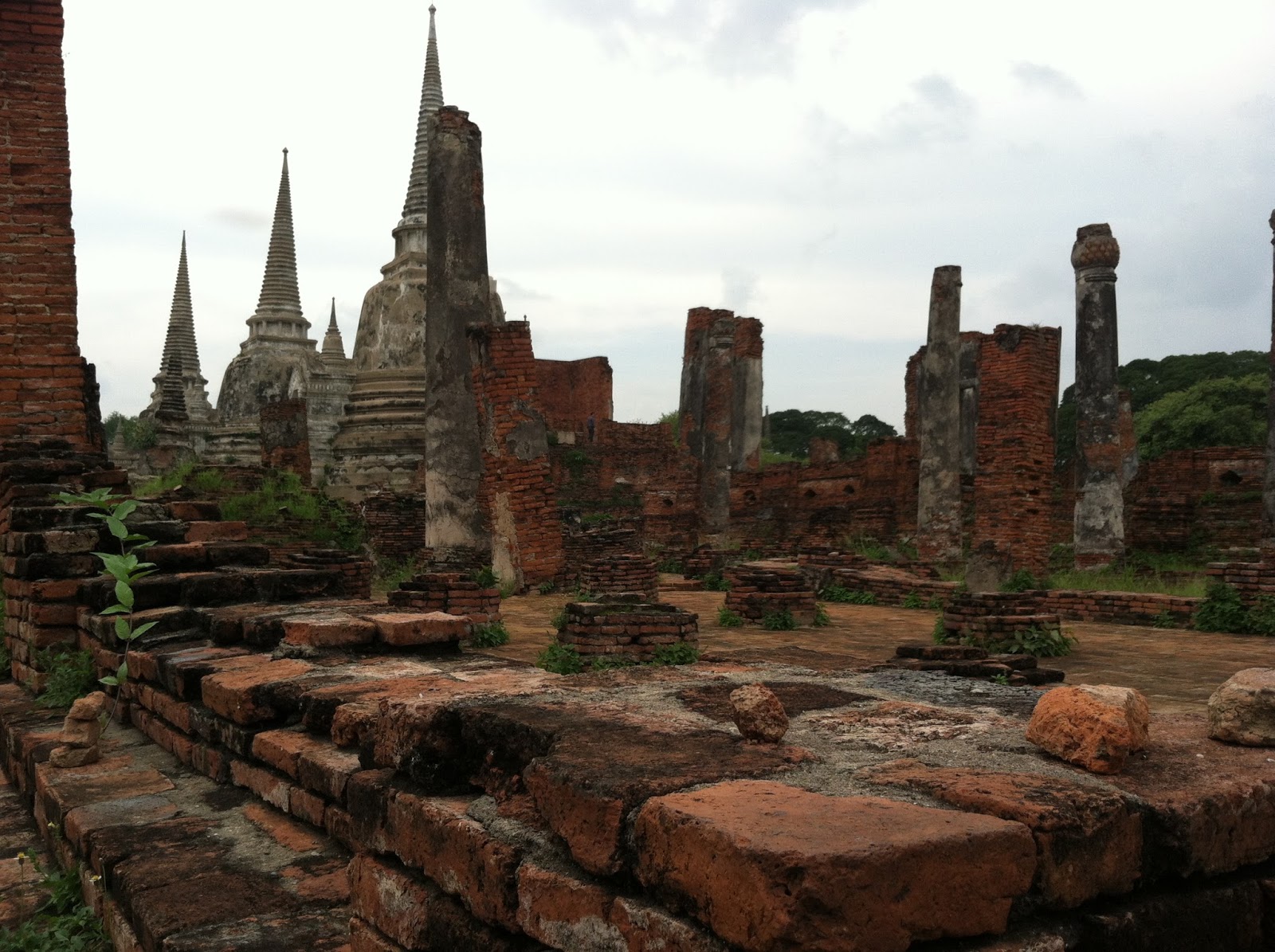
Though in ruin, the inherent geometric beauty of the city layout remains.

The Ayutthaya Elephant Village

For most people, riding elephants ranks high on the bucket list.  For a mere $15 USD (500 baht), you can scratch this one off the list.  One of the elephant trainers will seat you atop your very own elephant and walk you around the ruins.


After the ride is over, there is a souvenir shop where proceeds go directly to helping the elephants.  Walk around the village and get lost in the endless market full of every kind of food imaginable.


Wednesday, September 4, 2013

สำหรับประสบการณ์ที่ "For the Experience"

After seven long hours of training, I was ready for my first Saturday in Thailand to come to an end.  I was in a state of blissful exhaustion; one of those moods where all you want to do is absorb the environment around you rather than participate in it.

The Thai evening began its warm embrace of darkness and jungle sweat - from waxy green leaves rose a mysterious and enduring symphony of endless insects, vendors ran out of coconuts, and nocturnal millipedes glided gracefully across the black asphalt like shadows.  Street dogs lay on the side of the road in a coma-like sleep.  Food stalls were draped off with tarps and the lonely flourescent light of the 7-11 burned on into the coming night.

Yet on this night, the camp was far from asleep; the cars and vans of the gym owners sat waiting, loaded with Thai fighters and farang (foreigners), ready to make a two-hour trek to the rural wilds of Bangkok, Amphawa Samutsongkram.  There was not enough room for everyone to go; the owners shuffled us around, talking to each other frantically in Thai.  I lucked out; the manager offered me a seat in the car with one of the trainers and two of the fighters who would be competing that night.

I rode with two fighters, both from vastly different worlds.  One was an Italian who had been fighting in Bangkok intermittently for the past several years.  The first time I met him was on one of the morning 10k runs; he was running through the wet heat of Bangkok...in a sweat suit.  Running through the most intense heat and humidity I had ever experienced...practically wrapped in a body bag, a thick black plastic suit for weight cutting.  He smiled as he recognized me from the gym, jogging by with a cordial Hello.  I was humbled immediately; not only did fighters run in this heat, they ran in this heat in sweat suits, and did it with a smile.

The second fighter was a thirteen-year-old Idaho boy with a lisp named Hunter.  You would never suspect by looking at him that he had over forty professional Muay Thai fights under his belt, or that he had lived in Japan and in fact spoke Japanese, or that he was living in Bangkok alone.  I no doubt believed him when he stated, authoritatively and without the slightest hesitation, "I will fight in the UFC when I grow up."  This thirteen-year-old was far more fearless and wise than many adults I knew.

"I hate it when other kids think I'm just some sort of nerd, or that I can't fight." He laughed with a kind of self-assurance most men couldn't muster, musing that "I can always kick their ass, though!"

I wondered in awe at how someone could be so young and already have lived so fiercely, so fully, so fantastically.  I wondered in awe at how I could be so privileged as to meet such amazing and inspiring people.

In the midst of this reverie, we made a 7-11 stop so that the Italian could refuel.  Come to find out that not only had he been cutting weight, but that his weigh-in was only an hour --- one hour --- before his fight.  He sat in the backseat sucking down a coconut before passing out for the rest of the ride, trying to get back some iota of the energy drained away running through Bangkok in a sweat suit.
Amphawa Floating Market, Thailand

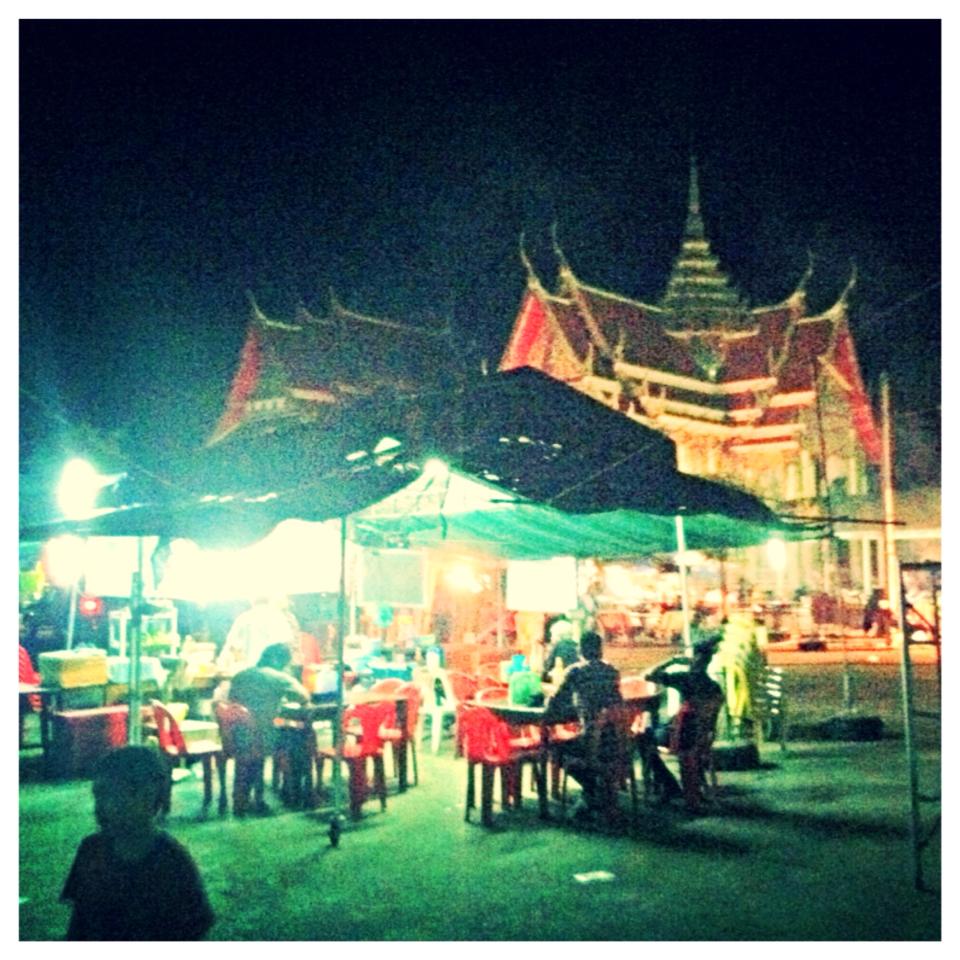
We arrived in Amphawa at almost ten at night.  The stadium was an open-air festival, a stage set up on wild grass and between decaying, ancient Thai buildings.  Amphawa is a sleepy river town known mostly for its floating market, but when the boats are docked and Saturday night sets in, the town comes alive for Muay Thai.  Hundreds of spectators stand or sit in folding chairs, sandwiched between ice cream vendors and the giant dancing stage pulsating with live music and gyrating half-naked Thai women.  Outside the archways and beyond the grass, street food vendors fill the paved parking lot, filling the air with the scent of fried meats and the sugary-sweet of Cokes from glass bottles.
Food Vendor outside the stadium fights of Amphawa

Full rules Muay Thai was already underway as we crowded backstage to prepare the fighters.  They were rubbed down head to toe in Thai oil and greased for the purpose of making it harder to land a deadly blow.  They lay on the pavement on worn grass mats, closing their eyes in focus, blocking out the world and its gyrating Thai women and screaming crowds.

We settled in to watch the fights before our Kaewsamrit fighters came on.  Hunter won his fight; the Italian lost.

As we drove home that night, the Thai coach told the Italian in broken English, "next time, you
Street food outside of the Amphawa fight arena

Entrance to Amphawa fight arena
fight for de experien."  The Italian paused for a moment, puzzled.  "If not for the experience, what then?"  The coach's English didn't stretch that far; the nuance of the abstraction was lost in translation.  Isn't all fighting for the experience, the experience of at least something, be it winning, money, or glory?  How does one fight for non-experience, other than to experience non-existence?  I thought of a quote I had just read from Siddhartha, about the way we experience life generally:

"When someone is seeking," said Siddartha, "It happens quite easily that he only sees the thing that he is seeking; that he is unable to find anything, unable to absorb anything, because he is only thinking of the thing he is seeking, because he has a goal, because he is obsessed with his goal.  Seeking means: to have a goal; but finding means: to be free, to be receptive, to have no goal.  You, O worthy one, are perhaps indeed a seeker, for in striving towards your goal, you do not see many things that are under your nose."  -Herman Hesse, Siddartha

What I took the coach to mean was this: if you focus only on winning or any other singular goal, you overwhelm yourself with tension and become blind to your opponent's maneuvers against you.  You lose the ability to "think like a fighter" and react to the situation you find yourself currently in, be it a clinch or a southpaw or a strange new style.  Many a fighting coach chants the familiar words to fighters, "relax, relax, relax."  What this means is to clear your mind of any goal, to focus only on absorbing the visceral reality of the situation, to trust utterly the instincts you have trained by merely following a flow of action and reaction based on the simple reality of what your senses perceive.  You see the punch, you block it.  You see the opening, you take it.  Bruce Lee explained it this way in his essay on gung fu:

"[the principle of gung fu] has to grow spontaneously, like a flower, in a mind free from emotions and desires.  The core principle of [this] is Tao - the spontaneity of the universe."

After explaining his initial frustrations with learning the "art of detachment" inherent in fighting, Lee explains his revelation further in his famous water analogy:

"On the sea I thought of all my past training and got mad at myself and punched the water!  Right then - at that moment - a thought suddenly struck me; was not this water the very essence of gung fu?  Hadn't this water just now illustrated to me the principle of gung fu?  I struck it but it did not suffer hurt.  Again I struck it with all of my might - yet it was not wounded!  I then tried to grasp a handful of it but this proved impossible.  This water, the softest substance in the world, which could be contained in the smallest jar, only seemed weak.  In reality, it could penetrate the hardest substance in the world.  That was it!  I wanted to be like the nature of water.
Lee continues, "Suddenly a bird flew by and cast its reflection on the water.  Right then as I was absorbing myself with the lesson of the water, another mystic sense of hidden meaning revealed itself to me; should not the thoughts and emotions I had when in front of an opponent pass like the reflection of the bird flying over the water?"

This was one possible interpretation of "for the experience."  As I contemplated what the coach's thoughts were, Hunter worked to help translate.  The coach spoke Thai and Japanese; Hunter spoke Japanese and English.  In a game of international telephone, Hunter asked the coach in Japanese what he had meant, then translating to English for the Italian.

"He means fight for the experience, as in don't focus just on winning or just on one thing.  Just relax, have fun, go with it, enjoy yourself," Hunter said.  Huh, I thought.  Not too far off the mark from what I was thinking of.

"Oh, okay, okay, I see what you mean," the Italian said.

As we drove home to the gym, mostly in silence, thunder and lightening lit up the entire skyline.  Rain loomed ahead of us, but the storm passed around us.  We drove on.  As the dark night flashed alive, I listened to the conversations in Thai and Japanese, devoid of meaning to me.  I sat empty, letting the world flow by and flow through me, absorbing as much of it as I could.

I closed my eyes and listened.  I thought of how unpredictable and at times extreme life in Bangkok could be, how wild and wonderful life in a Muay Thai camp was.  I savored it in its entirety, thinking of all the amazing things I had already done.

All amazing, if only I kept letting it be.  Fun, if only I kept letting go of fear.  An opportunity to truly grow and change, if only I kept relaxing.  All "for the experience."

Sunday Series - The Venomous Snake Farm of Bangkok


Every Sunday at Kaewsamrit is considered a rest day (i.e., no training).  Fighters typically spend the day recouping from the intensive training week by going about town to get massages, buffets, and shopping done.  Some opt to sleep the day away in the rooms, especially if he or she fought the night before.

For my first Sunday, I hit the streets of downtown Bangkok for a trip to the infamous Queen Saovabha Memorial Institute, also known as the venomous snake farm of Bangkok.  A somewhat offbeat yet popular tourist attraction, this place is a must-see for herpetologists and reptile enthusiasts visiting Bangkok.  It's a short walk away from other major tourist attractions like Lumphini Park, a place where you can also indulge a love of reptiles by viewing some of the naturally-occurring Asiatic Water Monitors swimming around like dinosaurs from some lost era.
View from the entrance, Queen Saovabha Memorial Institute

The Snake Farm is more than just a zoo or tourist attraction.  It is one of the world's leading producers of exotic venomous snake species antivenin.  The Institute itself began in 1912, when Thailand officially sponsored the Institute as a place for rabies vaccine research.  After producing several vaccines for the next decade, the institute opened as a "snake farm" in 1923, charging tourists a small fee to see the snakes in order to fund their invaluable snake antivenin research and services.  Because of Thailand's 175 species of snake, 48 of which are venomous, their work is prized by locals and foreigners alike.  Today, they house thousands of species of the world's most exotic venomous snakes (including the King Cobra and non-venomous but deadly Anaconda), specializing in snake husbandry and education.

As I set out from the camp Sunday morning, one of the trainers offered me a ride on his motorcycle into "town," or at least what's considered downtown for the small Bangkok suburb of Talingchan.  One thing I know in life is this: when a Thai trainer offers you a free motorcycle ride, you hop on, and then you say many thank-yous.   I took a taxi the rest of the way into the city.  The drive totaled about thirty minutes; this was a welcomed and rare relief from the Bangkok heat since cab drivers aren't shy about using the A.C.  You can get to this place by public transportation if you wish, but this will take about three times longer to get there.

The men at the gate kindly ushered me past the main building (pictured above) and to the ticket stand.  I spent several hours looking through the exhibits and watching the demonstrations.  Below is a summary of the information I gathered from the experience.  Overall, I would highly recommend this experience to travelers; like many things in Bangkok, it's cheap, it's exciting, and you won't find it anywhere else in the world.

I.  Basic Information:

Admission costs 200 baht (about 6 dollars) for adults, 50 baht for children.

The hours of operation:

Monday-Saturday: 9:30am to 3:30pm
Sundays and Holidays:  9:30am to 1:00pm

Show Times:
Monday-Saturday:
   Venom Extraction Demonstration, 11:00am
   Snake Handling Demonstration, 2:30pm

Sundays and Holidays:

    Snake Handling Demonstration, 11:00am


II.  The Snake Handling Demonstration

King Cobra brought out for snake handling demonstration
The audience sits behind a small wall or stands behind a chain while snake handlers bring out several venomous and some non-venomous species to show.  One main handler narrates the action in both English and Thai translations, a sort of tour guide full of information about the Institute and its serpentine residents.  

They start with the big ticket item: the King Cobra.  I stood behind the chain while several men brought out a King Cobra and plopped it on the floor in front of us, as if it were just some piece of furniture they were used to handling.  These handlers spend years working with the snakes, learning exactly how to do it without getting bit (although several do get bit each year, with occasional deaths).  Still, you have the option of standing only ten feet away from one of the world's most deadly snakes.  Because the King Cobra only senses movement, this is just like the scene in Jurassic Park where Grant faces down T-Rex: don't move, and he can't see you.  So there I stood, motionless as the cobra ten feet away stood up, flared it's hood and looked right past me.  No big movements.  No big movements.  I snapped a few pictures without moving my feet, the handlers keeping a close eye on the tourists crazy enough to get that close.

After the King Cobra, the handlers brought out several more species, my favorite being the Siamese Spitting Cobras.  As the handler taunted and aggravated the twin cobras, the narrator explained that the cobras could not see him standing still behind them.  He poked one of them jokingly in the head from behind and the snake dipped down like a toy float in a pool before looking around in front of it into the audience menacingly as if to say "WHO took my lunch money?!?"  Chuckling and gasps filled the air.

At the end of the show, the handlers bring out pythons for audience members to take pictures with, free of charge.


III.  A Few of Bangkok's Venomous Snakes

Green Tree Python

Monocellate (Albino) Cobra
Indochinese Spitting Cobra

Green Anaconda; not venomous, but still deadly due to it's size and power.

For a more detailed list of Thailand's venomous snakes, go here.

IV.  The Basics of Venomous Snake Bites: How it Works

What exactly is snake venom?  It's an evolutionary twist on saliva, modified through thousands of years of natural selection, to serve two principle purposes.  First, it demobilizes prey so that the snake can eat the prey whole.  Aside from the two fangs which function like hypodermic needles, snake have no teeth, nor do they masticate (or "chew").  The snake will actually detach its jaw bones to facilitate swallowing.  Thus, snake venom eliminates the problem of a struggling meal during this process (non-venomous snakes deal with this problem through the familiar Jiu Jitsu solution of suffocation).  Second, venom demobilization serves as a defense mechanism.

There are two main types of snake zootoxins or venom: neurotoxins and cytotoxins.  Each is a combination of proteins, enzymes, and polypeptides that typically act on different vertebrate systems of the body.

Neurotoxins:
These act on neuron receptors in the body's cells, essentially changing the signal or "message" that cells receive.  By either overstimulating or blocking the nerve signals, these proteins can manipulate the body into conditions of muscle tetanus and heart failure, or cause complete muscle paralysis.
       Fasciculins: these cause muscle tetanus by overstimulating the nerves in the muscles, which leads to heart failure.  Species include black mambas and some rattlesnakes.

        Dendrotoxins:  these cause muscle failure or paralysis by doing the exact opposite of fasciculins - allowing NO nerve impulses to transmit.  Species include cobras and sea snakes.

Cytotoxins:
These have specific effects on only certain types of cells, and are thus more specific and less generalized than neurotoxins.  These include cardiotoxins (those that stop the heart, found in King Cobras) and hemotoxins (those that destroy blood cells or cause coagulation, found in multiple species of cobras and vipers).

For more information on snake venom, go here.

Saturday, August 31, 2013

Day One, Part Two - The Language of Muay Thai

I don't speak Thai.  Not a word.  In fact, before I began my first day of training, the only Thai words I knew were "Muay Thai."

Here I am, this English-speaking lawyer who spent her entire life fine-tuning the niceties of language, the subtleties of wordplay, and the rules of grammar.  I can write you a legal brief and outline an article as if it were second-nature.  I can analyze, rationalize, proselytize, orate, narrate, and speak in Lawyer as if I were speaking in tongues, if you'd like.  After a lifetime of reading, writing, poetry --- years of formal education, endless hours alone with words --- I can be a dancing one-woman show of words.  Sure, no problem.

Most of the trainers didn't understand much of what I said, aside from the most basic of information like my name and the country I'm from.  I wanted to tell them all about how much I loved their sport, how much I admired it, how much I respected everything they stood for, and how invaluable their training would be to me.  But, I was at a loss for words; there was no Thai in my brain to explain it.

But Muay Thai is a universal language in and of itself.  I came to realize this during my first day training in a different country with a formidable language barrier.  I didn't need to explain how much I loved their sport; everything I wanted to say about it translated with perfect clarity through each punch, kick, and check that I did.

For all the English I had studied, I had immersed myself in a second language for the past year without really knowing it; with each day of training, I had been learning the language of Muay Thai.   I had been building a universal physical vocabulary that would work for me whichever Muay Thai gym I should go to, no matter the spoken language.  No words can ever translate a teep or an elbow; no words are necessary.

As soon as I began to work with the trainers and hit the pads and bags, the language of Muay Thai spoke for me.  My work denoted what my experience level was, so I didn't need to tell them; they could see what I already knew, exactly what changes to make, and where I could be better.   English became irrelevant.  Spinning elbows, teeps, sweeps, jabs, rights, low kicks; these all became the words we all knew.  The combinations became the sentences with which we would speak to each other.  Sparring would be our conversations; it was the same back-and-forth flow of physical poetry I knew from Blackhouse, the very same I fell in love with what seems like the longest year ago.  And if the practitioners and teachers of Muay Thai are poets, then these men are the Shakespeares.  After all is said and done, I find myself again to be a student of language and poetry, this time spoken with the "eight limbs."  A situation new but all-too-familiar, comforting in its homeliness, strikingly reassuring.


Wednesday, August 28, 2013

Day One, Part One - The Sound of Bangkok

"Coooock-a-doodle-doo, motherfucker!"

My eyes snapped open instantly.  Huh, I thought, waking with the roosters.  I really only thought that happened in movies.  Guess not.  I looked over at my cell phone, an alarm set for thirty minutes later, now rendered useless by the natural process of this place.  No, Western Girl, you don't need a cell phone to wake up, not here.

At about four thirty in the morning, in the complete absence of light, in a small room in the thick heat of a small Bangkok suburb miles from the city, a merry band of roosters began to crow outside of my window.  Just outside my window.  They did so insistently, constantly; I half expected one of them to scratch through my window and peck me awake, a look in his eye saying, "time to train, get up, RUN!"

Soon after, the steady beat of body parts smacking bags streamed through my window.  Every three minutes or so, the sound of a bell (the old-school kind, rung by hand, nothing electronic) punctuated the grunts and exertions of the men training and the coaches yelling outside.  Just outside my window.  The world of Muay Thai, just a short walk outside my bedroom door.


I heard far more of Bangkok before I ever saw it.  I arrived in the middle of the night, midnight to be exact, after a seventeen hour journey by airplane; a three hour layover in Japan sandwiched between two seven-hour flights.  I hardly remember the airport in Tokyo.  I remember shuffling around in a circle, dazed, hulking luggage awkwardly, ready to shank someone for a bottle of water and a comfortable place to sit.  Soup, I thought, water.  LORD GIVE ME SOUP.  WATER.  LIQUIDS.  NOW.  I stopped my no doubt super sexy zombie walk in front of a glowing airport restaurant sign illuminated with giant, detailed pictures of authentic Japanese Soba and teriyaki chicken.  Bottles of water tucked away neatly in a tiny counter fridge, standing regimented in Romaji-written rows like soldiers ready to fight the exhaustion of travel.  Beckoning me, calling to me; drink, and you shall be restored.  Stop.  Rest.

Stop and rest I did.  I ate like a sick child, tired, slurping soup slowly and oblivious to the world around me for a few moments of blissful relief.  When I eventually stood up to leave, a few Japanese girls gasped in awe at my stuffed killer whale (named Shmu) tucked under my arm.  They approached me excitedly and asked me something in Japanese, pointing to Shmu with giant smiles.  "SeaWorld, San Diego," I said.  Nothing but blank stares.  I tried something more general.  "Uhh, California."  This got knowing nods and exclamations; "Ohhhh, California! Dolphin, yes?"  The tour guide in me couldn't help it.  I pointed to Shmu with my best tour guide smile and said, "killer whale, orca."  They were positively ecstatic at this information.  I let them pet Shmu for a few minutes.  Then, with some energy renewed and a single-mindedness to get to Bangkok, I turned over my empty bowls and headed for the next flight.

Hot Japanese Soba Noodles and Teriyaki Chicken, Narita Airport, Japan


I should mention here that these were my fist international flights, so I was also pleasantly surprised at the fact that I got served free hot food.  All of my domestic flights have never done this; usually, it's just a small, overpriced deli menu of fruit and cheese plates and wine.  You can see how thoroughly I enjoyed this little perk:


Thank you, Delta Airlines.  I also appreciated the small screen provided for each seat which allowed me to play unlimited movies, TV, and chart where the flight was at:


When I finally arrived at the airport in Suvarnabhumi, I longed for a bed and a good night's sleep.  I stepped off the plane and the heat and humidity hit me like a punch to the face.  I was squeezed onto a packed bus to the terminal, all of us tired and sweating on each other.  Drops of water fell on my shoulder.  The air conditioning unit dripped moisture down in a slow stream.  I eventually met up with and found the escort from the gym who would pick me up.  After a brief introduction, we took a taxi to the camp for about forty minutes.  I was useless during this time, half-awake, half-listening to the gym instructor-escort and taxi driver laugh and talk jovially in Thai.  I paid him, got a room and a key, and I practically fell onto the bed, lights out cold.

This morning, as I lay in the dark and listened in awe to the sounds of this new reality, I could feel the truth of that presence just outside my window with all the senses aside from sight; I could hear it, I could smell it as Thai cooking from the gym kitchen, I could touch it in the rough feel of the sheets, I could taste it in the humid air.  A dream finally made real.

Some moments, when the reality of a major decision sets in, you question if what you did was right.  If it at all made sense.

This was not one of those moments - there was absolutely no question, laying there in the dark on a typical Bangkok Thursday morning.  As I felt the day bloom around me, I felt a sense of excitement, belonging and content before I even set foot outside.  This was it.  No more planning to be done.  I had set up the door, now all I had to do was literally walk through it, go outside, and begin.

So I did.

Tuesday, August 27, 2013

10 Steps Before You Go to Thailand. Step Three - Passports, Visas, & Documentation

3.  Getting the Right Documents in Order

Which documents do I need to get into Thailand?  The following is a general road map of where to start.  There are several good American and Thai legal resources online that offer complimentary information that can answer many of the more specific questions you may have.  My favorite is Thai Embassy.  It's a website partnered with Siam Legal International Services, one of biggest and most experienced firms handling Thai Visa and travel information.  

 Keep in mind that the world of Thai Immigration Law is vast, complicated, often poorly translated into English, and confusing.  If you plan to stay longer than thirty days, it may be worth it to pony up some money and pay a firm or lawyer to answer some of your trickier questions.  The last thing anybody wants or needs is to get all the way to the airport in Thailand and be immediately ordered back onto a plane ride home.  If any of these resources don't cover your situation, really consider consulting a professional on the issue.

***As always, DISCLAIMER:  I am NOT YET an attorney because I am still awaiting Bar Exam results.  I am NOT your attorney.  You are NOT my client.  This is NOT legal advice, nor do we have any sort of attorney-client relationship.  I am NOT soliciting ANY clients. This constitutes general travel advice based on personal experience.

GENERAL STARTING POINTS:

Less than thirty days AND a U.S. citizen?  Passport required.  See below.

More than thirty days AND a U.S. citizen?  Passport AND Thai Visa (or "Visa Runs") required.  See below.

A.  PASSPORT.


No matter what the duration of your stay, you must get a passport if you do not already have one.  If this is the kind of thing you're interested in enough to be reading this blog, you should have a passport anyway.  Passports generally are good for ten years and it's a good thing to have around so you can travel on short notice.

Several Tips for Passports:
  • If you already have a passport, make sure it is valid for at least six months AFTER your projected arrival in Thailand.  Stated alternatively, your passport should not have an expiration date sooner than six months from the day you arrive in Thailand.  EXAMPLE:  You are arriving in Thailand on June 1.  Your passport expires on November 20th.  This is an expiration date that is sooner than six months after June 1 (in this example, your passport needs to have an expiration date after December 1).  Thus, in this this example, you would need to renew your passport.
  • If you do NOT already have a passport, apply for one AS SOON AS POSSIBLE.  Getting a passport can be time consuming because you have to deal with a government agency to get it done.  The processing time varies (mine was 6-10 weeks as stated but took only four) and you should check with the office at which you want it processed.  You can apply for a passport at most local U.S. post offices.  More specifically, you can locate where there is an office near you (officially termed an "Acceptance Facility") at this website through the U.S. Bureau of Consular Affairs.  The U.S. Department of State has thorough information on exactly how to apply for a U.S. passport for first-time and repeat applicants, broken down into seven steps.  The basic scenario looks like this: you fill out some forms, bring those little 2-by-2 photos and your identifying documents with you to an office, pay a fee, and they will send you a passport in the mail (along with your identifying documents) within the time frame they give you.  GET THIS OUT OF THE WAY - IT'S THE EASY PART.  

B.  VISAS:  EXEMPTIONS, TOURIST VISAS, AND NON-IMMIGRANT VISAS.


STAYING LESS THAN THIRTY DAYS:

i.  THE VISA EXEMPTION


Well, what country will you be entering Thailand from?  And will you be entering by land travel (train, bus) or by air?

For citizens of the following 48 countries (U.S. included.  Go here for the full list), you do not need a Visa if:


  1. The purpose of your visit if for TOURISM (read: NOT working, starting a business, going to school, etc.); AND
  2. You have PROOF OF ONWARD TRAVEL (a return ticket showing a departure date within thirty days of arrival; proof of exit by air gets you the full thirty days, while proof of exit by land gets you fifteen days); AND
  3. You have proof of at least 20,000 baht per person per month (find a Thai Baht to USD converter through Google; type in Baht to USD).

If these ALL apply, a person has statutorily-granted Visa exemption status under the Visa Exemption Rule created in 2008.

STAYING LONGER THAN THIRTY DAYS:

ii.  THE THAI TOURIST VISA


This Visa allows you to stay in the country for 60 days for the same kind of tourist purpose as the kind listed above (i.e., this does not allow you to work, etc.)  To get this Visa, you must essentially:

  • Submit an application in person or by mail to a U.S. Thai Consulate Office (download from the website of the Consulate to which you are applying.  Find the office nearest you by looking through the Thai Embassy list.  A popular office is the one in Los Angeles.  The application PDF for the L.A. Office can be found here).
  • Pay $40 with the application (money order) and submit supporting documents along with the application (varies by Consular Office; typically includes 2 passport-size 2" by 2" photos, proof of return plane ticket, and address of where you will stay in Thailand).
  • SUBMIT THE APPLICATION AT LEAST TEN (10) BUSINESS DAYS BEFORE YOUR DEPARTURE DATE.  Keep in mind that the Visa MUST BE USED WITHIN THREE (3) MONTHS of when it is granted to you.  What does this mean?  It's best to apply about 1-2 months out from your departure date; this way, there is plenty of time to process the application, but you can shift around your flight date if needed without running out the three month clock of redeeming the Visa in Thailand.


The initial Visa can be extended for another 30 days by going to the Immigration Office in Bangkok and paying an additional $60 fee (1,900 baht).  An "additional extension" can be granted to keep you seven days beyond this 30 day extension.  This means the total time you can eek out of a Tourist Visa is 3 months + 7 days.  You might be able to extend beyond this for"emergency purposes."


WORKING IN THAILAND, STUDYING ABROAD, OR NON-TOURIST PURPOSES:

iii.  THE THAI NON-IMMIGRANT VISA.

This type of Visa has more complicated requirements in addition to those above, namely this: you will need to have a job or school that will vouch for you BEFORE you can apply for the Visa.  Details on these types of Visa can be found at the Royal Thai Consulate of Los Angeles. 

Keeping Everything in Order

Once you have your applications and requirements in order and in hand, you should create a fail-safe physical and digital back-up file for all of your travel documents.  

Creating the File:
  • First, buy one of those accordion folders with dividers or something similar.  Make this the place where ALL of your important papers will go when you're abroad.  In addition to your passport and I.D., you should make copies of the applications you submitted for your passport and Visa.  
  • Make copies of other important documents and keep one copy in the file to go with you abroad and one copy to stay with someone back home.  What you are doing is essentially creating a "dummy" file for yourself.  This way, if you lose anything or it gets stolen, you have someone to call back home who is holding originals of EVERYTHING.  Suggestions for this file:  copy of passport ID page, Visa, emergency contacts, immunization records, birth certificate, Driver's License, maps, transcripts, resumes, degrees and certifications, medical and dental information, plane tickets, etc.
  • GUARD THIS FILE!  Keep it in a LOCKED place (there are plenty of locking briefcases out there if your camp doesn't have lockers or safes).  Obviously, always bring this with you on planes (NOT checked in luggage) and don't walk around with it in public when it's not necessary.  

Friday, August 23, 2013

10 Steps Before You Go to Thailand. Step Two - Finances

2.  Budgeting The Trip

DISCLAIMER.  The following is general travel advice and in no way represents legal advice, does not solicit legal advice, and does not form any attorney-client relationship with any reader whatsoever.  Reminder:  I am NOT YET A LICENSED ATTORNEY and am NOT giving legal advice in this post or on this website.

Personally, I saved the money in advance and will live off of a savings account while in Thailand.  When saving money for the trip, keep in mind how much you should actually be saving by creating a realistic budget plan.

Here is a basic overview of the categories you can use to plan your budget:

Sample Budget Sheet
Item
Cost
Total

Travel/One-Time Expenses

Plane Tickets1
____

Visa Fees2
____

Travel Insurance3
____

Immunizations4
____
____


Bills/Monthly Expenses

Credit Cards5
____

Phone/Data Usage6
____

Transportation 7
____

Food8
Entertainment9
____
____

Training Camp10
____
____

Totals


1.  Plane Tickets.  The standard low-end rate for a round trip ticket runs about $1200 from California.  The cheapest way to plan it?  Make all of your arrival/departure dates on Tuesdays.  Check out Kayak for cheap airfare.

2.  Visa Fees.    Visa Fees may or may not apply.  Staying less than 30 days + have a current U.S. passport + have a return plane ticket?  U.S. citizens carrying a tourist passport and in possession of an onward or return airline ticket do not require a visa to enter Thailand. The passport must have at least six months validity remaining to be allowed entry.  Upon entry, Thai immigration officials will place an immigration stamp in the passport permitting a 30-day stay in Thailand if arriving by air or a 15-day stay if arriving by land.  Planning on staying longer than 30 days?  You'll need to pick from among various Visa options.  For more information on Thai Visas, visit the U.S. Embassy site.  Visa processing fees generally range from about $30-80 but are subject to change, so stay up to date with the Royal Thai Consulate office that will be processing your Visa application.  The Consulate has offices in New York, Los Angeles, Chicago, and Honolulu, among others.  The website does not offer a comprehensive list of Consulate locations, but it's a good place to start.

3.  Travel Insurance.  You typically have an option to purchase travel insurance along with your plane ticket for an additional $100 or so.  You can, of course, always shop around for different travel insurance.

4.  Immunizations.  Depending on your immunization history and whether your health insurance will cover the cost of "non-routine" shots for travel, the immunizations for Thailand can run from $150 to $900 or more (the cost of Rabies or Japanese Encephalitis shots are OBSCENELY EXPENSIVE no matter where you go).  If you are insured, start by talking to your primary physician.  If you are not insured, start by Googling local travel immunization services in your area and shop around for a competitive price.

5.  Credit Cards.  Unfortunately, credit card companies won't stop billing your debt just because you're going abroad.  You can suspend a lot of bills while you're gone, but keep in mind that credit cards will still need to be paid.

6.  Phone/Data Plans.  Most plans don't offer good international rates in my experience.  The cheapest option is to suspend your service while abroad and use the abundant free wifi of Bangkok to communicate or just buy calling cards/prepaid plans from a provider in Thailand.

7.  Transportation.  Good news.  Between buses, tuk-tuks, and taxis, public transportation in Thailand is both abundant and cheap.  The low end of getting around Bangkok should run about $5-10 per day, but plan on paying more if you're going long distances in taxis or making a lot of trips to different parts of town.  See more about the Bangkok transportation system here.

8.  Food.  Also good news.  Food ranges from the super cheap street food to five star dining.  The low end is probably $5-15 per day.  For more on this topic, see Migrationology's website.

9.  Entertainment.  This really depends on how much you plan to screw around when not training.  Plan which activities you know you can't live without (example: $250 visit to the Tiger Temple Tour outside of Bangkok) into the budget.  Between all of the free sightseeing (temples, markets, etc.) and the cheap nightlife, staying entertained on a budget really isn't much of an issue.

10.  Training Camp.  This one depends entirely on the factors discussed in step one.  Reminders: check out the camp websites, shop around, try to negotiate with the camp/gym owner for a better rate.

Monday, August 19, 2013

Physics, Punches, and Gender Expectations: The Lucia Rijker Documentary

"So I punch like a girl...but maybe I could kick your ass."  -Lucia Rijker


"OMG, I am SOOOO into reading about love horoscopes.  It's like, totally something I follow about celebrities.  It's SOOOO interesting!" I heard this little gem from one of the girls sitting next to me on the plane to Honolulu.  No, not girls - these two next to me were girls in women's bodies.  They were mid-twenty somethings in terms of physical age, but mental middle-schoolers.  What a shame, I thought.  Six hours removed from media and internet; you could fill each of those hours with literary mental giants the likes of Whitman, Faulkner, Kerouac, Palahniuk.  Engage in the lost art of...thinking...real, introspective, substantive reflection and reading...sans computers.  But, no.  For six hours I watched them flip their hair, take plane selfies, and read magazines plastered with half-starved, photoshopped reality stars, idolizing them for...what, exactly?  For being followed by cameras?  For looking good?  For being shameless about a need for attention?  For having sex on camera?  For...an example?  An example of what?

Who else can girls really look up to these days?  And as an example of what?

For me, Lucia Rijker has always been a woman I look up to.  Not only as a fighter, but as an example of how a woman should be.  Strong and peaceful.  Powerful and classy.  Disciplined and determined.  Confident and kind.

Lucia Rijker
I've always loved the Lucia Rijker documentary Shadowboxers (see video above for YouTube link to documentary).  It highlights women's boxing in 1999, a primordial time in female combative sports in comparison to the modern-day Rousey era.  Moreover, it's a great look at Lucia Rijker "The Dutch Destroyer."  Dubbed "the most dangerous woman in the world," Rijker has a professional boxing record of 17-0, fourteen of which were by knockout.  Most of you might recognize her as "Billy the Blue Bear" from Million Dollar Baby.

More than a fighter, Rijker is a devoted professional martial artist in mind, body, and soul.  She is a Buddhist who speaks four languages, devoting daily energy to meditation and chanting.  She is the kind of woman you want to listen to whenever she speaks because you know there will be some deep-reaching wisdom to be found in her words about fighting, training, about life.  About more than horoscopes or celebrities or who's fucking who.

In this ten-minute clip from the show "Sports Science," Lucia breaks through expectations and proves that some women can in fact punch just as hard (if not harder) than men.  Her punches answer the doofy question in the beginning, "can a GIRL possibly hit as hard as a GUY?!?" with a solid, "of course, and as a measurable fact, I punch harder than a lot of guys."


Saturday, August 17, 2013

10 Steps Before You Go to Thailand. Step One - Researching Camps and Prices

Fights at the Thammasat University Convention Center in Bangkok, Thailand 
So you want to go to Thailand to train Muay Thai?  These ten steps address the question, "HOW do I make that happen?"  Before you get to how, you need to ask yourself a few questions:

Why do you want to do this?  What's the purpose for you?  If you're looking to just spend a week or two at a camp and come home, your goals are probably significantly different than someone looking to spend a more substantial amount of time at a camp.  Whether you are a casual observer of the sport or a seasoned fighter, your goals will shape how you should plan your trip.  Whether your goals be improved fitness, adventure, or getting a title shot, make a list of all of the reasons you want to go.  After you've made your list, think about how much time and dedication to training it will actually take to reach those goals; despite popular belief inspired by many a montage, you won't go from beginner to pro in two weeks.

When can you go?  How much time away from your other commitments can you take?  When will you have money to invest in this endeavor?  Is this a bucket-list plan that will happen a few years from now, or next month?  Timing your trip around other things in your life can become the biggest challenge to taking the trip (aside from financing such an adventure).

Once you have that basic mental picture painted, it's time to consider more specific steps.


1.       Research the Camps and Locations.

I began by looking up the gym that my Kru trained at, and that connection largely influenced my decision to train there.  However, there are many, many, MANY (did I say many?) gyms to choose from.  It's a veritable buffet of camps to look at; it is, after all, the birthplace and country of the sport.  Many locals now capitalize on that fact and, to the delight of many a farang, camps seem to be everywhere, and with the competitive market comes competitive pricing for the experience.  The overall message here?  Shop.Around.For.The.Right.Camp.

Fairtex Camps - highly overpriced at nearly SIX TIMES the rate of any other camp


Factors to Consider.  Where in Thailand do you want to stay for the duration of your training?  Do you want a pristine beach scene like Phuket or the humming big city life of Bangkok?  There are camps all over Thailand to choose from, and many of them have websites with pricing and contact information.  Many MMA/Muay Thai forums are teeming with reviews of the camps and tidbits of advice about each.  Some gyms get a reputation for catering to tourists while some are known as less friendly.  This part of the research is really up to you; comb through the information and decide what looks good according to your goals.  Seek out people who have similar training goals as yourself who have trained in Thailand, and pick their brain.  Here are some factors to consider in picking your camp and gym:

Price.  Prices range from a few hundred dollars a month to the obscene rates at Fairtex.  How much can you afford?  Most gyms are very upfront with pricing and have it posted on their websites.  As with anything in Thailand, keep in mind that if you haggle with them, you may get a sweeter deal than what's posted as the price.  

Location.  What kind of locale do you want to train in?  Big city Bangkok?  Near the beach?  Do you want to stay in one camp the whole time, or hop around to a few different locations during your trip? Research what each city has to offer and decide which city/cities will fit your needs best, and that's one way to narrow down the list of which camp(s) you want to train at.


Reputation.  Each gym has its own roster of champions and fighters, and each gym is usually known for something - be it a specific style of fighting, a certain regimen of training, catering to tourists, catering to locals, etc etc.  This kind of information is hard to find without talking to people; talk to people who have trained at the gym(s) you're interested in.  No one around who's been there?  Check out the forums and blogs - there's plenty of information there.  Try Sherdog forums or Muay Thai Focus to start.  Also, many of the links at the end of this page have forums / discussion boards about the pros and cons of training in specific locations.

Cheaper Apartment Option at Eminent Air Gym, Bangkok
Bungalow Room Option at Eminent Air Gym, Bangkok
Accommodations.  How comfortable (or uncomfortable) are you willing to be on this trip?  Most gyms offer two options: AirCon or Fan Rooms.  AirCon are air conditioned, and always cost a bit more.  Fan rooms force you to deal with the incredible heat sans air conditioning.  If you haven't trained in hot, humid conditions before, the AirCon is probably worth the extra money you'll spend.  

Personal connections to the gym.  Do you already know people training at other camps?  Consider the benefits of being around familiar faces when you're busting your ass and showing up on day one with at least someone you know will have your back.  If you have such connections, use them.  This is, of course, your journey - who you know should only be one factor in the decision of where to go.  Perhaps striking out into the unknown is more your scene.  

However you weigh these various factors in your decision, make sure you've thought it through before you move on to the next step of charting your journey: financing.

Here are some links to sites that have thoroughly categorized and reviewed many of the gyms in Thailand:


Stay tuned for Step Two - Financing Your Trip